
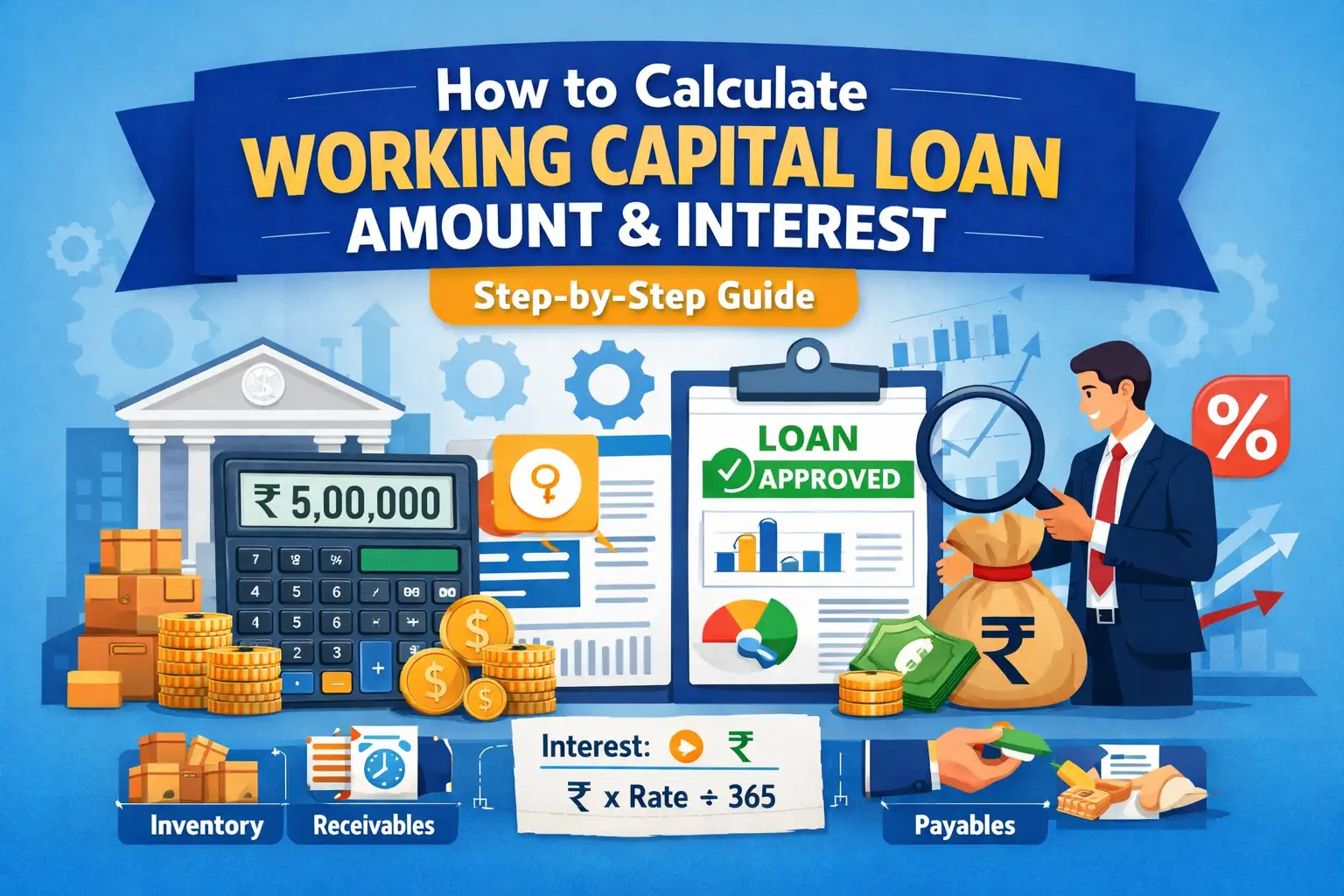
How to Calculate Working Capital Loan Amount and Interest in India
A company can show strong sales numbers and still struggle to pay bills on time. Cash may be locked in raw materials, customers may take weeks to settle invoices, and statutory payments continue regardless of collections. These timing gaps create pressure even in otherwise healthy enterprises.
Working capital funding exists to absorb this pressure.
However, many owners submit loan requests without understanding how lenders estimate actual requirements or compute interest charges in operating accounts. That lack of preparation often leads to sanctioned limits that fall short of expectations, prolonged processing, or borrowing costs that appear unnecessarily high.
This article walks through how to calculate working capital loan amount & interest in a clear and practical way. You will see how banks evaluate cash cycles, how eligibility is derived, and how interest accumulates—so you can approach financing decisions with confidence rather than guesswork.
Working Capital Loan Highlights
Understanding the Role of a Working Capital Loan
A working capital loan is short-term business finance meant to keep daily activity running smoothly. It does not fund property purchases or plant expansion. Instead, it supports expenses such as procurement of stock, payroll, rent, utilities, statutory dues, and the waiting period between dispatching goods and receiving payment.
Lenders provide this facility in several formats depending on how the business operates. Many firms use revolving arrangements like cash credit or overdraft accounts, which allow withdrawals up to a sanctioned ceiling and charge interest only on the portion actually utilised. Some enterprises prefer structured working capital term loans with scheduled repayments, while others rely on invoice-linked funding to convert outstanding receivables into immediate liquidity.
Although the products differ in design, they all serve the same core purpose: ensuring uninterrupted cash flow during the operating cycle.
Recent Posts
How Banks Decide Your Working Capital Requirement
Before sanctioning a limit, lenders analyse your business cycle, turnover, financial statements, GST data, and bank account behaviour. Their goal is to see how much money is tied up in operations at any point in time and how smoothly cash flows through your account.
One common approach is the operating cycle method. Here, the bank studies how many days you hold inventory, how long customers take to pay you, and how much credit suppliers give. The longer your money stays stuck in stock and receivables, the higher your working capital need becomes.
Another method is the turnover approach, which is often used for MSMEs and service businesses. Under this, banks estimate working capital as a fixed percentage of annual sales—commonly around 20 to 25 percent, depending on industry risk and margins.
Lenders also rely heavily on bank statements. They check average bank balance, monthly credits, cheque returns, overdraft usage, and seasonality. If cash inflows are stable and routed properly through accounts, eligibility improves significantly.
The Basic Formula for Working Capital Requirement
At its simplest, working capital requirement can be expressed as:
Inventory + Receivables – Payables = Working Capital Needed
Inventory means the value of raw material and finished goods you normally keep. Receivables are amounts customers still have to pay you. Payables are what you owe suppliers.
Banks convert these numbers into days and multiply them by your average daily sales or cost of production to estimate how much money is blocked in the cycle.
Example: Calculating Working Capital for a Manufacturing Business
Suppose a small manufacturing company has annual sales of ₹12 crore, which works out to ₹1 crore per month.
The business keeps about 45 days of inventory, collects payments from customers in 60 days, and pays suppliers in 30 days.
The operating cycle is calculated as inventory days plus receivable days minus payable days. That becomes 45 + 60 – 30 = 75 days.
Seventy-five days is roughly two and a half months. If monthly sales are ₹1 crore, then money tied up in operations is around ₹2.5 crore.
This ₹2.5 crore is the gross working capital requirement. From this, banks may expect the promoter to bring in a margin—say 20 to 30 percent from own funds. If the margin is 25 percent, the borrower contributes ₹62.5 lakh, and the bank may consider financing around ₹1.87 crore as working capital.
How Banks Arrive at the Sanctioned Loan Amount
The final sanctioned amount is rarely equal to the gross requirement. Banks reduce it based on margin rules, existing loans, and collateral coverage.
They also calculate something called drawing power. Drawing power is the portion of your limit you are allowed to use at any time based on current stock and receivables statements submitted every month. If your stock falls, the usable amount reduces even if the sanctioned limit remains the same.
If collateral such as property or fixed deposits is available, pricing may improve and sanctioning becomes easier, though many MSME working capital loans today are approved on cash-flow strength rather than security alone.
How Interest on a Working Capital Loan Is Calculated
This is where many business owners get confused. Interest on working capital is usually charged on a daily outstanding balance, not on the full sanctioned limit.
For example, if your cash credit limit is ₹1 crore but you only use ₹40 lakh for ten days, interest is charged only on ₹40 lakh for those ten days.
Banks apply an annual interest rate and convert it into a daily rate by dividing it by 365. The daily interest is then multiplied by the outstanding balance for that day. At the end of the month, all daily amounts are added and debited to your account.
Working capital term loans work slightly differently. In those cases, interest is calculated on a reducing balance every month, similar to regular business loans, and you repay through fixed EMIs.
Interest Calculation Example
Assume you have a cash credit limit of ₹50 lakh at an interest rate of 11 percent per annum.
If for one month you used an average of ₹30 lakh, the calculation would roughly be:
Annual interest on ₹30 lakh at 11 percent equals ₹3.3 lakh. Dividing this by 12 gives about ₹27,500 for that month.
If utilisation changes daily, the bank will compute it more precisely based on daily outstanding amounts rather than averages, but the logic remains the same.
Factors That Influence Your Interest Rate
Interest rates on working capital loans are not fixed for everyone. They depend on your credit score, GST turnover consistency, profitability, and how disciplined your bank account operations are.
Businesses with regular inflows, low cheque bounces, proper GST filings, and audited financials usually get better pricing. Industries considered volatile or seasonal may face higher rates. Loans backed by collateral or government guarantee schemes often enjoy slightly lower interest.
Public sector banks and NBFCs also price differently, depending on their risk appetite and cost of funds.
How to Reduce Interest and Improve Eligibility
Improving your eligibility starts months before applying for a loan. Routing all sales through bank accounts instead of cash helps show genuine turnover. Filing GST on time and matching it with financial statements builds lender confidence.
Keeping cheque returns to zero, maintaining a healthy average balance, and reducing unnecessary overdraft usage can significantly improve sanction chances. Cleaning up old loan accounts, settling overdues, and correcting credit report errors are also crucial.
Many businesses benefit from getting their working capital proposal professionally structured so that financial statements, projections, and operating cycle data are presented clearly in bank formats.
Common Mistakes Businesses Make
A frequent error is asking for a random loan amount without calculation. Banks almost always recompute requirements, and unrealistic requests weaken credibility.
Another mistake is operating multiple bank accounts with scattered inflows, which makes cash flow look thin. Under-reporting sales to save tax may help in the short term but hurts borrowing capacity badly.
Delayed stock statements, mismatched GST returns, and frequent cheque bounces are also red flags that reduce limits or lead to rejection.
A frequent error is asking for a random loan amount without calculation. Banks almost always recompute requirements, and unrealistic requests weaken credibility.
Another mistake is operating multiple bank accounts with scattered inflows, which makes cash flow look thin. Under-reporting sales to save tax may help in the short term but hurts borrowing capacity badly.
Delayed stock statements, mismatched GST returns, and frequent cheque bounces are also red flags that reduce limits or lead to rejection.
Final Thoughts :
Understanding how to calculate working capital loan amount & interest puts you in a much stronger position when dealing with banks. Instead of guessing, you can approach lenders with realistic expectations, proper data, and a well-prepared proposal.
A little planning before applying often means higher sanctions, faster approvals, and lower interest costs—exactly what growing businesses need.
Frequently Asked Questions On How to Calculate Working Capital Loan Amount & Interest
Banks often start with a benchmark of around 20%–25% of annual turnover, but the final limit depends on your operating cycle, margin requirements, banking pattern, and overall cash-flow strength.
Collateral is not always compulsory, especially in many MSME-focused programs. However, lenders will still evaluate business stability, financial statements, and repayment capability. Collateral can improve pricing and approval comfort.
In cash credit or overdraft accounts, interest is usually charged on a daily outstanding basis and then debited monthly. This means you pay interest only on the amount you actually use, not the full sanctioned limit.
Drawing power is the portion of your sanctioned limit you can use at a given time. It is calculated based on stock and receivables after applying the bank’s margin. If your stock/receivables reduce, drawing power can reduce even if the sanctioned limit stays the same.
Yes. Banks commonly cross-check GST returns with financial statements and bank credits to verify real turnover and receivables. Clean, consistent GST filings generally support better eligibility.
Recent Posts
Contact Us
1204 GD – ITL Building, B-08,
Netaji Subhash Place, Delhi-110034
Email: ceo@nkbkredit.com
Phone: +91 7503211000, +91 9654981031
Services
Important Links
Disclaimer
This website functions as a working capital–focused advisory channel supporting individuals and businesses seeking structured funding solutions. Advisory, documentation, and lender coordination services are provided by NKB Kredit Solutions Pvt. Ltd., a registered Indian company offering business finance advisory services.
Copyright © 2026 All Rights Reserved by NKB Kredit Solutions (P) Ltd.